


October 16, 2026
What CIOs Must Get Right| Executive Lens Episode 9
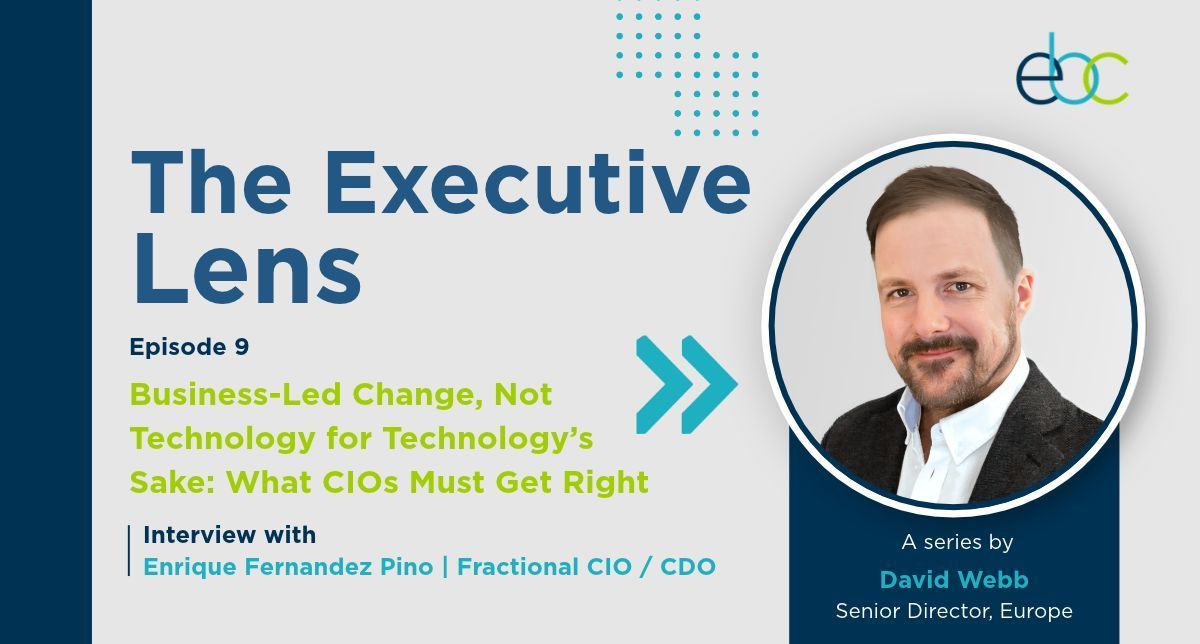
As organisations race to adopt AI, modernise systems, and digitise operations, many are discovering the same uncomfortable truth: technology alone does not create transformation.
According to experienced business change leader Enrique, too many organisations still approach change from the wrong starting point by treating technology as the objective rather than the enabler.
After more than 30 years leading technology-enabled transformation, including serving as Group CIO within a FTSE 250 business, Enrique’s perspective is clear:
“Technology-led change should never really be technology-led. It has to be business-led change with technology as the enabler.”
For boards and executive teams navigating AI adoption, operational transformation, and digital investment, this distinction matters more than ever.
From Lawyer to CIO: An Unconventional Route to Leadership
Enrique’s path into technology leadership was far from traditional.
Having begun his career as a lawyer in Spain, he transitioned into corporate project work before eventually moving into large-scale business transformation and technology leadership.
The turning point came when repeated frustrations with IT delivery pushed him to better understand the discipline himself.
“I joined the enemy,” he jokes, reflecting on his decision to move into technology functions rather than remain frustrated by them.
The transition was not easy. Surrounded by architects, infrastructure specialists, and technical language he initially struggled to understand, Enrique spent evenings teaching himself networking, systems, and technology fundamentals from scratch.
It took time, nearly two years before he felt fully comfortable, but the experience shaped his philosophy permanently.
“To lead business change well, you need a really good understanding of technology.”
Not to become a technologist, but to bridge business and technology effectively.
The CIO Role Is Changing and the “C” Matters Most
For Enrique, one of the biggest misconceptions in technology leadership is misunderstanding the CIO title itself.
“The most important letter in CIO is the ‘C’. You are a business leader first.”
Historically, many CIOs have remained too close to operational technology and too far from commercial reality. As a result, technology teams often struggle to gain executive trust or secure investment for transformation.
The role, he believes, is evolving.
Modern CIOs must increasingly act as:
- Business leaders
- AI and information enablers
- Translators between technical teams and executive stakeholders
- Drivers of EBITDA and commercial outcomes
Operations matter, but operational excellence alone is no longer enough.
“No one cares about the guts of the technology. They care whether the business performs better.”
AI Is the Future, But the Hype Is Ahead of Reality
Unlike some executives, Enrique is unequivocal about the importance of AI.
“This is not a fad.”
But he also believes many organisations are approaching adoption incorrectly.
Drawing comparisons to the early internet era, Enrique sees today’s market sitting within the familiar pattern of the Gartner hype cycle, inflated expectations followed by inevitable disillusionment.
The issue is not the technology itself. It is pace and execution.
Many CEOs are asking teams to “AI the business” without first understanding:
- What problem they are solving
- Where AI creates measurable value
- Whether their organisation is operationally ready
“AI cannot be technology-led change. It has to be business-led.”
Organisations that rush large-scale transformation without clarity risk wasted investment, poor adoption, and change fatigue across teams.
The Data Problem Nobody Wants to Talk About
For many organisations, the greatest barrier to AI readiness is not capability. It is data quality.
In Enrique’s experience, even relatively young businesses often suffer from fragmented systems, inconsistent information, and poorly maintained data environments.
The result?
Data teams spend the majority of their time cleaning information rather than extracting insight.
“In many organisations, 80% of the effort goes into finding and cleansing data, and only 20% into actual data science.”
For executives eager to accelerate AI programmes, this can be a difficult reality to hear. But without clean, connected data, advanced analytics and automation rarely deliver meaningful returns.
The challenge is particularly acute in older organisations, where years of disconnected systems and shadow IT have compounded complexity.
Why Change Fatigue Destroys Good Transformation
Technology may move quickly. People do not.
One of Enrique’s strongest messages is that human change has a natural pace, and leaders ignore this at their own risk.
When transformation programmes move faster than teams can absorb, organisations often experience:
- Change fatigue
- Resistance to adoption
- Disengagement
- Burnout
“You cannot transform an organisation through grand statements. You have to start small, prove value, and build momentum.”
This often requires managing executive expectations carefully, particularly when stakeholders expect immediate results from complex change programmes.
The best transformation leaders know how to maintain momentum while pacing change realistically.
Learning, Incremental Improvement and Long-Term Thinking
For Enrique, successful transformation is rarely about one dramatic initiative.
Instead, it comes from consistently learning and improving.
Using the evolution of Formula One pit stops as an analogy, from several minutes in the 1950s to under two seconds today, he highlights how incremental learning compounds into significant outcomes.
The lesson for technology leaders is clear:
Continuous improvement beats sweeping declarations.
AI, data, and transformation should not begin with ambitious slogans. They should begin with focused use cases, measurable outcomes, and lessons applied repeatedly over time.
Advice for Future Technology Leaders
For aspiring CIOs and business change leaders, Enrique offers straightforward advice:
Understand the Business First
Spend time where work actually happens, whether factories, depots, stores, or customer environments.
“Put the steel-toe boots on.”
Technology leaders cannot solve problems they do not understand.
Stay Humble
Assume there is context behind every process.
People often work in certain ways for legitimate reasons. Understanding those realities before introducing technology is essential.
Embrace Technology, Don’t Resist It
AI, automation, and digital tools are not optional.
“Resisting AI today is like resisting the internet twenty years ago.”
Leaders do not need to love every technology trend, but they do need to understand how it changes the operating environment.
What This Means for Hiring
As organisations navigate AI adoption and increasingly complex transformation agendas, demand is growing for a different type of technology leader.
Not purely technical specialists, but commercially minded transformation leaders who can bridge business priorities with technology execution.
Increasingly, organisations need leaders who can:
- Translate complexity into business language
- Align technology investment with EBITDA and growth
- Manage organisational change realistically
- Drive AI adoption with commercial discipline
- Operate confidently across both business and technology environments
At EBC, we work closely with executive teams, boards, and investors to identify leaders who can deliver meaningful transformation through business-led change that creates measurable value.
This article forms part of EBC’s ongoing leadership series exploring how executive roles are evolving across technology, finance, and transformation. Reach out at david.webb@ethosbc.com