


June 15, 2026
Transformation in the Age of AI | Executive Lens Episode 8
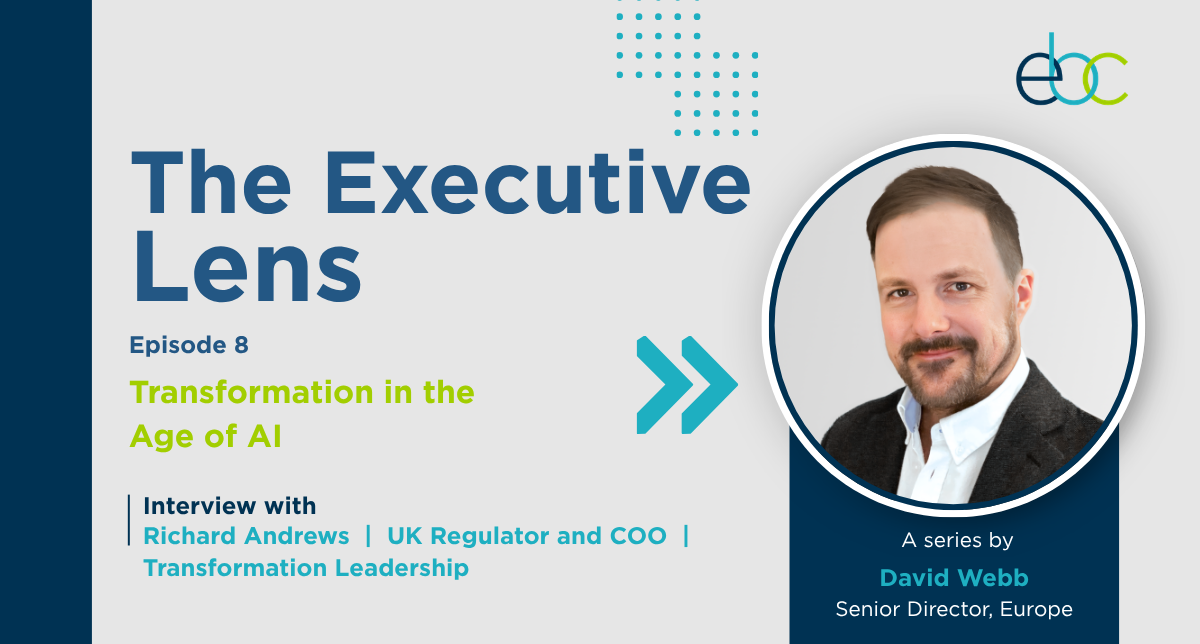
In today’s business landscape, transformation has become a constant rather than a one-time initiative. Organisations are under pressure to evolve faster than ever, driven by digital disruption, emerging technologies, and shifting customer expectations.
Yet despite the growing investment in transformation programmes, many initiatives fail to deliver meaningful results. According to transformation leader Richard Andrews, the difference between success and failure often comes down to leadership clarity, stakeholder alignment, and the ability to continuously adapt.
Drawing on more than two decades of experience spanning banking, consulting, digital transformation and executive leadership, Andrews shares key insights on what it really takes to lead change in today’s environment.
Transformation Starts With People, Not Technology
While emerging technologies, particularly AI, dominate today’s business conversations, Andrews believes organisations often misunderstand where transformation truly begins.
Technology may enable change, but it does not drive it. “The number one skill you need isn’t being the best strategist or programme manager,” he explains. “It’s stakeholder management.”
In large transformation programmes, misalignment between teams is one of the most common causes of failure. Different departments often focus narrowly on their own objectives rather than understanding how their work contributes to the broader programme.
Successful transformation leaders take a different approach. They map stakeholders early, gather perspectives across the organisation, and surface issues openly. These conversations can be uncomfortable, but they are essential.
When perception gaps between teams are addressed early, organisations can realign around shared goals and dramatically improve delivery outcomes.
AI Is Accelerating Change, but most Organisations Aren’t Ready
Artificial intelligence is rapidly reshaping how organisations operate, but the reality is more complex than many headlines suggest. While many companies claim to be implementing AI transformation, Andrews argues that much of the current activity remains experimental.
“There are a lot of proof-of-concept projects happening,” he says. “But when you look closely, very few organisations are deploying AI at scale.”
Before AI can truly transform operations, businesses must first address foundational issues such as:
- Migrating systems to the cloud
- Integrating fragmented technology platforms
- Ensuring clean, accessible data
- Streamlining internal processes
Without these fundamentals in place, AI initiatives risk becoming isolated experiments rather than enterprise-wide capabilities.
For transformation professionals, this means their role remains critical. Organisations still need programme leaders, change specialists, and cross-functional teams to guide the complex work required to modernise their infrastructure.
The Talent Impact: White-Collar Work Is Being Rewritten
One of the most significant implications of AI lies in its potential impact on professional careers.
Historically, automation has primarily affected operational and administrative roles. However, AI’s ability to analyse data and support decision-making means the technology is increasingly moving into areas traditionally occupied by highly educated professionals.
Roles in law, finance, consulting, and accounting could see significant shifts as AI automates large portions of routine analytical work. This shift also raises an important structural challenge for organisations.
Entry-level roles have long served as training grounds for future leaders. If many of these tasks are automated, companies may struggle to develop the next generation of experienced professionals.
“This could break the traditional career ladder,” Andrews notes.
For individuals entering the workforce, the key will be focusing on roles that combine technical understanding with human skills, areas where collaboration, judgement, and leadership remain essential.
Leadership in Transformation: Balancing Today and Tomorrow
For senior leaders, particularly Managing Directors or business unit heads, transformation requires a delicate balance between operational performance and future strategy.
On one hand, leaders must run a disciplined, profitable business today. On the other hand, they must continually evolve their organisation to stay relevant tomorrow. This requires constant monitoring of core business metrics, such as utilisation, revenue, pricing, and pipeline, while also identifying new opportunities for growth.
“Your current products or services won’t necessarily be the ones that define your business in five years,” Andrews explains.
Leaders must regularly assess where the market is heading and adapt accordingly. That may involve launching new service lines, investing in emerging technologies, or even shutting down business units that no longer deliver value. These decisions can be difficult, particularly when they involve teams that leaders have built themselves, but avoiding change often creates far greater risks.
Continuous Learning Is the Real Competitive Advantage
In an environment defined by rapid change, Andrews believes one mindset stands above all others, continuous learning.
Throughout his career, he has consistently invested in developing new skills, whether through executive education programmes, consulting training, or learning new languages. The goal is not simply acquiring knowledge. It is maintaining mental agility.
“I think continuous learning keeps your brain firing on all cylinders,” he says. “It helps you analyse problems faster and respond to challenges more effectively.”
For leaders navigating complex transformation programmes, this intellectual flexibility is invaluable.
The Power of Career Leaps
Looking back on his own career, Andrews highlights the importance of taking calculated risks.
Early in his career, he left a stable role in retail banking to join a digital agency during the early days of the internet, accepting a pay cut and losing traditional benefits in the process. The move proved transformative.
It placed him at the centre of the first wave of digital innovation and set the trajectory for the rest of his career in transformation and consulting. Opportunities like this often appear risky at the time. However, they can open doors to entirely new industries and experiences.
“Sometimes you have to grab an opportunity with both hands and run with it,” he says.
Transformation Never Stops
If there is one lesson Andrews emphasises above all others, it is that transformation is never truly finished.
Markets evolve. Technology advances. Customer expectations shift.
The organisations that thrive are those that embrace continuous reinvention, led by leaders who remain curious, adaptable, and focused on the future. Technology may be changing the rules of business, but ultimately the success of transformation still comes down to the same core principle.
People leading change with clarity, courage, and vision.