


June 15, 2026
Technology Leadership Beyond Infrastructure | Executive Lens Episode 4
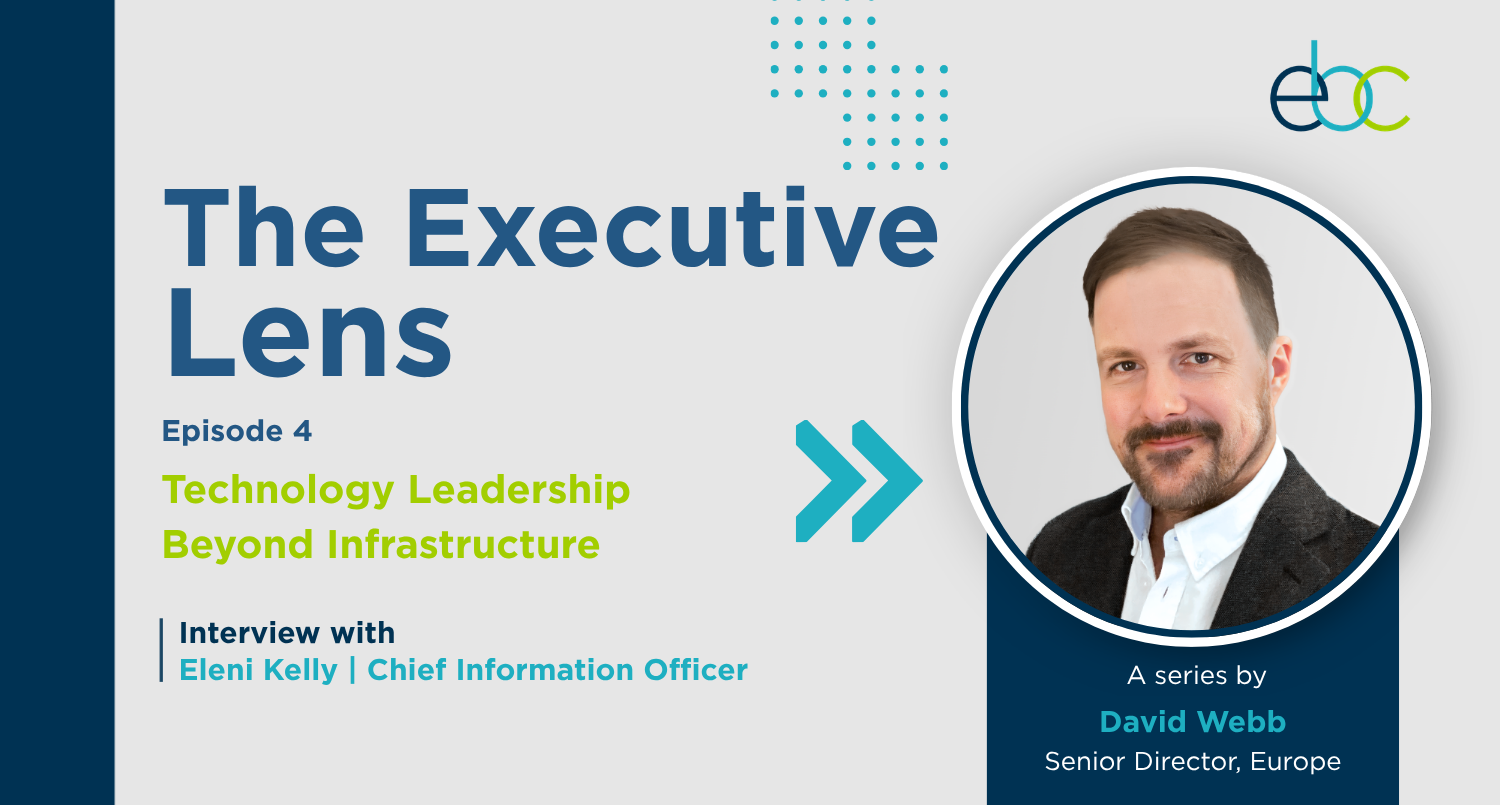
Technology leadership is at a critical inflexion point. As artificial intelligence, low-code platforms, and automation make technology more accessible than ever, the traditional boundaries of the CIO role are being redrawn. The question many organisations now face is no longer whether technology matters, but how technology leadership delivers measurable business value.
According to experienced CIO Eleni Kelly, this moment represents both a risk and an opportunity. For CIOs who remain focused solely on infrastructure and operations, influence is eroding. For those who can translate technology into commercial outcomes, the role has never been more important.
From Technologist to Business Leader
Eleni’s career spans both the private and public sectors, with senior leadership roles across financial services, government, and complex transformation environments. Having started her career as a developer, she retains a deep technical foundation, but her leadership philosophy has evolved well beyond code.
“The principles of IT don’t really change,” she explains. “What changes is the context, the stakeholders, the scrutiny, and the need to explain why something matters.”
Her experience in the public sector proved particularly formative. Navigating ministers, departments, regulators, and delivery teams required a different kind of leadership, one rooted in communication, accessibility, and alignment. Technology initiatives could not succeed unless they were understood and supported at every level.
That experience now shapes how she approaches CIO roles: not as a technologist protecting a domain, but as a business leader connecting the dots.
Why the CIO Seat Is Under Pressure
AI has fundamentally changed the technology landscape. Tools that once required deep technical expertise are now accessible to non-technical users. Board members can ask AI to explain APIs, data architectures, or integration strategies in plain language.
This accessibility is powerful but it also shifts expectations. “If technology becomes understandable to everyone,” Eleni notes, “then CIOs can no longer justify their seat at the table by technical knowledge alone.”
Without a clear commercial narrative, ownership of technology decisions risks drifting elsewhere — to CFOs managing cost, COOs managing efficiency, or Chief Product Officers owning innovation. The CIO becomes relegated to infrastructure oversight unless they actively reclaim strategic relevance.
The answer, Eleni believes, lies in reframing the role around outcomes.
From Technology Spend to Business Value
One of the most persistent challenges for CIOs is securing investment in areas that are essential but not immediately visible particularly technical debt. “Technical debt is not exciting,” Eleni says. “No CFO wants to fund a server upgrade just because the code is old.”
The mistake many organisations make is framing these conversations in technical terms. Faster code or cleaner architecture rarely resonates outside IT. What does resonate is risk reduction, resilience, scalability, and enablement.
Whether it is reducing exposure to cyber threats, enabling AI adoption through better data foundations, or improving customer experience through modern platforms, technical debt must be translated into business impact.
In this sense, the CIO becomes a storyteller not in abstract terms, but in commercial language that aligns technology decisions to organisational priorities.
Architecture, Governance, and the Long View
As low-code platforms and “citizen developers” become more prevalent, Eleni sees governance and architectural clarity as more important than ever.
“Accessibility doesn’t remove complexity,” she explains. “It changes who can create it.”
Without strong architectural oversight, organisations risk fragmented systems, inconsistent data, and hidden long-term costs. The CIO’s role is to hold an end-to-end view, ensuring innovation happens within a framework that supports scale, security, and sustainability.
This also reshapes the relationship between CIOs, CTOs, and Chief Product Officers. While the CTO may build the engine and the product team defines features, the CIO ensures the organisation can actually run the car — safely, efficiently, and with a clear destination in mind.
Leadership, Impact, and the Human Dimension
For Eleni, technology leadership has always been about more than systems. One of the defining moments of her career came outside the corporate environment, when she served as a digital governor at a primary school during the early stages of COVID-19.
By enabling access to digital learning tools for children who would not otherwise have had them, technology became tangible in its impact.
“That’s when it really hit me,” she reflects. “This isn’t just about building systems. This is about changing lives.”
That perspective underpins her leadership approach today. Technology must be purposeful. If what is being built does not materially improve outcomes for users, customers, or communities, then it is worth questioning whether it should be built at all.
What CIOs Must Get Right
When asked about the non-negotiables for modern CIOs, Eleni is clear:
- Commercial fluency — understanding financial metrics, P&L dynamics, and how the business wins and loses clients
- Client proximity — spending time with customers to understand whether technology is actually delivering value
- Narrative ownership — explaining technology in outcomes, not abstractions
- Depth with curiosity — maintaining technical credibility while remaining open to change
In an era where technology roles are increasingly blurred, these capabilities differentiate leaders who remain influential from those who become marginalised.
What This Means for Hiring
The traditional CIO profile is no longer sufficient. Organisations navigating AI adoption, digital transformation, or complex change need technology leaders who can operate as full business partners. They need CIOs who:
- Translate complexity into clarity
- Balance innovation with governance
- Connect technology investment to commercial outcomes
- Lead across functions, not just IT
At EBC, we work closely with boards, executive teams, and founders to identify technology leaders who can operate effectively at these inflexion points, where judgement, communication, and strategic alignment matter as much as technical expertise.
This article forms part of EBC’s ongoing leadership series exploring how executive roles are evolving in response to structural change across technology, finance, and growth.
I recruit transformation and change leadership for organisations navigating complex change. If you are building this capability, or exploring your next move, I would be happy to talk. Reach out at
david.webb@ethosbc.com