

May 29, 2026
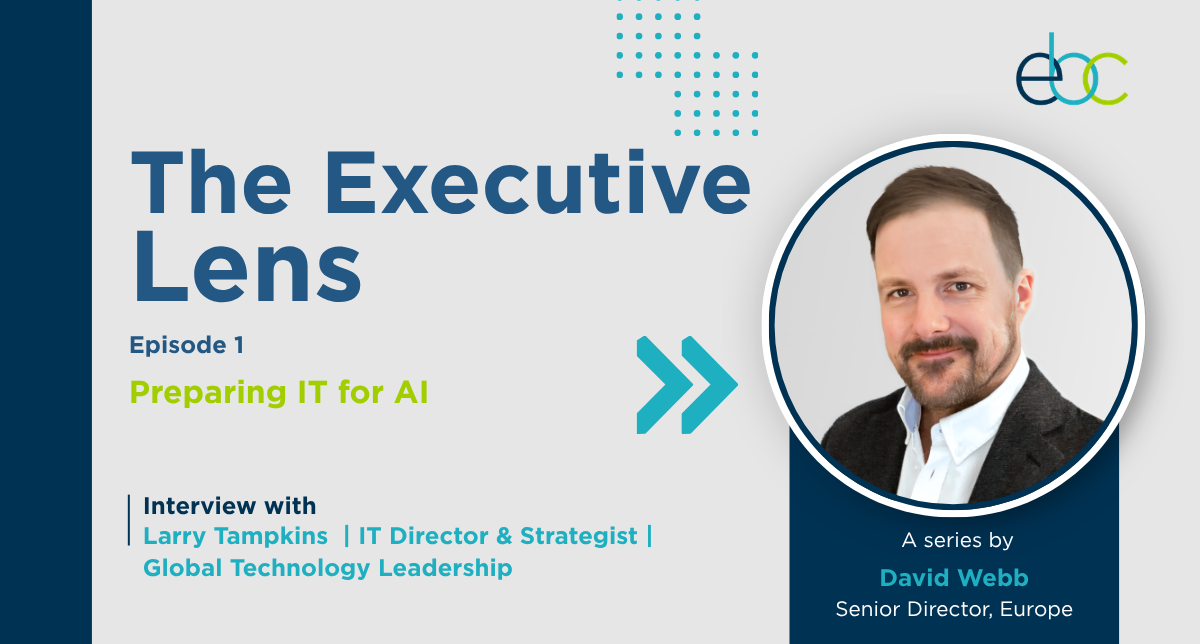
Preparing IT for AI | Executive Lens Episode 1
Every technology conversation right now starts with AI.
Which tools to adopt. Which vendors to trust. Which use cases to prioritise. How fast to move.
But Larry Tampkins — an IT strategist who has led global IT across private equity-backed, acquisitive and multinational businesses, covering strategy, transformation and navigating multiple M&A integrations along the way — thinks most organisations are asking the wrong questions first.
The uncomfortable truth about AI readiness
Larry's view is simple and not particularly comfortable: AI doesn't fix bad data. It amplifies it.
If your processes are messy, your data is siloed, and your systems weren't built to talk to each other, then adopting AI doesn't solve those problems. It makes them move faster.
"Crap, really fast."
The uncomfortable reality is that data silos were being discussed twenty years ago.
Most organisations never fixed them — not because the solutions didn't exist, but because they never built the internal muscle to keep data clean as new systems arrived. AI is now exposing that in a way that's very difficult to ignore.
The foundation that actually matters
What Larry advocates for — and what he built during years of M&A work — is a clean separation between operational systems and data platforms.
Every acquisition added another ERP. The only way to maintain coherent reporting and scenario planning across that complexity was to pull data into a separate platform entirely. That separation protected core systems, gave teams real-time visibility, and made it possible to plan across a fragmented business.
That same principle now applies to AI. If you want to use AI to make better decisions, you need a platform where clean, structured, accessible data lives.
Without that, you're building on sand.
The skill nobody is talking about
Beyond data architecture, Larry makes a point that gets overlooked in almost every conversation about technology leadership: communication.
Not soft-skills-as-an-afterthought communication. Communication as a strategic capability. His framing: every document an IT leader produces is a sales document.
If it's unclear, leadership loses confidence in technology. If it's jargon-heavy, budgets don't get approved.
The IT leaders who succeed long-term can translate complexity into clarity for a CFO, a COO, a board, and an operations team — all in the same week.
What this means for hiring
The most in-demand IT professionals right now aren't defined by their tool stack.
They're defined by their ability to build the foundations that make everything else possible — and explain why those foundations matter to people who don't speak technology.
That's a rare combination. And as AI accelerates, the gap between organisations that have it and those that don't is going to become very visible, very quickly.