The intersection of artificial intelligence and employment law is no longer a future concern for Singapore businesses — it is a present-day compliance challenge. With the Workplace Fairness Act (WFA) now in force, employers who are deploying AI tools across hiring, performance management, and workforce planning face a clear obligation: ensure that every decision made — or supported — by technology meets the same standard of fairness, accountability, and transparency as one made by a human.
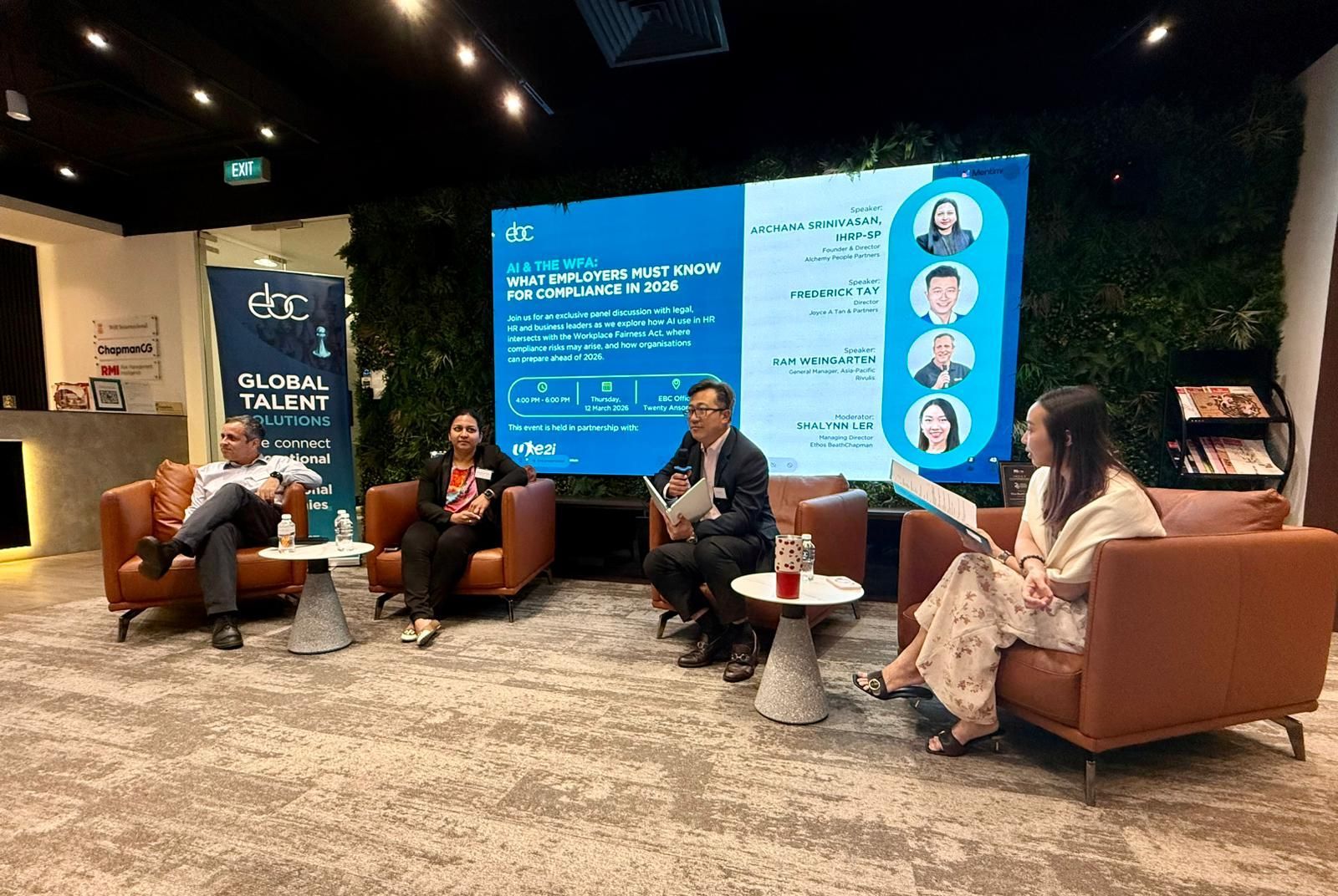
At a recent EBC roundtable on AI and WFA compliance, practitioners from across Singapore's business community came together to examine what good practice looks like — and where the gaps remain. Four clear priorities emerged.
1. Fairness Must Be Demonstrable — Not Just Intended
Good intentions are no longer sufficient. Under the WFA, every HR decision — whether it relates to hiring, promotion, or termination — must be transparent, accountable, and defensible. This means documentation is not a back-office function; it is a frontline compliance requirement.
For organisations using AI in any part of their talent process, this raises an important question: can you explain, in plain terms, why a candidate was shortlisted or rejected? If the answer is no, you are exposed. Employers need to be able to produce a clear, human-readable rationale for decisions — one that will withstand scrutiny from regulators, employees, and tribunals alike.
2. Strong HR Foundations Come Before AI Tools
There is a temptation to treat AI as a solution to HR inefficiencies. In practice, AI amplifies what is already there — for better or worse. If your processes are unclear, your decision-making authority is ambiguous, or your team is inconsistently applying policies, AI will not fix that. It will embed it.
Before deploying any AI tool, organisations should conduct an honest review of their existing HR processes, clarify who owns key decision points, and ensure that teams are equipped to implement WFA requirements confidently and consistently. The technology should follow the process — not substitute for it.
3. AI Governance Is an Ongoing Discipline, Not a One-Off Exercise
Implementing an AI tool and walking away is not governance — it is a liability. The roundtable was clear on this point: test, audit, and monitor AI tools before use and at every stage thereafter.
One practical approach gaining traction is the use of scenario workshops and playout exercises to surface hidden biases before they affect real decisions. Running your AI tool through edge cases — diverse candidate profiles, non-traditional career paths, candidates with employment gaps — helps identify where the system may be producing skewed outcomes. Doing this before launch, and regularly thereafter, is fast becoming a baseline expectation for responsible AI deployment in HR.
4. Human Judgement Remains Non-Negotiable
Perhaps the most important message from the discussion: AI should assist human decision-making, not replace it. Automating low-risk, administrative tasks — scheduling, initial screening, data collation — is appropriate and efficient. But critical people decisions must remain in human hands.
This is not simply a legal position — it is a practical one. AI systems, however sophisticated, do not carry accountability. The organisation does. Keeping humans at the centre of consequential decisions is both a compliance requirement under the WFA and a sound risk management principle.
The Bottom Line
Singapore's WFA has raised the bar for every employer, regardless of size or sector. For organisations integrating AI into their workforce processes, the bar is higher still. The firms that will navigate this landscape most effectively are those that treat fairness as a design requirement, not an afterthought — building it into their processes, their technology choices, and their governance structures from the ground up.
EBC's consultants across banking & financial services, technology, legal, risk & compliance, insurance, and commerce & industry are available to provide expert commentary on these themes. For interview requests or data inquiries, contact the EBC Marketing team at marketing@ethosbc.com